About Battle Climb Racing

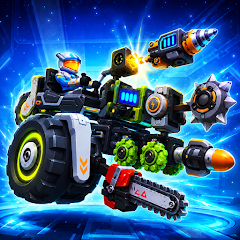
The moment you tap the icon, the game throws you straight into the garage. No tutorial, no hand-holding — just a grid of parts and a empty chassis waiting for your input. You drag an engine onto the frame, then wheels, then a weapon. The physics engine kicks in immediately, adjusting the center of gravity as you add weight. This is not a typical racing game where you pick a car and go. You are the engineer, and the game makes that clear from the first second.
The garage is the heart of the experience. You have a selection of blocks: engines with different power ratings, wheels with varying grip levels, weapons like lasers and cannons, and boosters for speed bursts. Each part changes the car's behavior on the track. A heavy engine gives more power but reduces handling. Larger wheels improve stability on rough terrain but slow acceleration. The game does not explain these trade-offs. You learn them by trial and error, which is both frustrating and rewarding. The first few builds will likely fail spectacularly, flipping over on the first hill or getting stuck in a crater. That is part of the design.
Physics, Terrain, and the Car Builder — A Workflow That Bites Back
The physics system is where the game shows its depth. Each planet in the campaign has different gravity and terrain. On the moon, low gravity means your car floats and bounces, making precise landings difficult. On lava planets, the ground is uneven and slippery, requiring a low center of gravity and wide wheelbase. The car builder lets you adjust for these conditions, but the game never tells you which parts work best where. You have to experiment. A car built for speed on flat ground will spin out on a hill climb. A car built for stability will be too slow for PVP races. This creates a tension between building for the campaign and building for multiplayer.
The original observation here is that the car builder and the physics engine are at odds. The builder gives you freedom, but the physics punishes poor choices harshly. A player who spends hours crafting a sleek, fast car might find it useless on the first alien track because it lacks the ground clearance to clear a rock. The game does not provide a test track or a simulation mode to preview how a build will perform. You have to enter a race to find out, and if you lose, you go back to the garage and start over. This trial-and-error loop is the core gameplay loop, and it is both the game's strength and its weakness. It rewards patience and experimentation, but it also frustrates players who just want to race.
Real-World Performance — Ads, Bugs, and the Offline Promise
The game runs smoothly on most modern Android devices. Frame rates are stable, and the graphics, while not top-tier, are serviceable for a mobile game. The offline mode works as advertised — you can play the campaign without an internet connection. However, the online PVP mode requires a stable connection, and matchmaking can be slow. The biggest performance issue is not technical but economic: the ads. Every race ends with a forced video ad. Every time you try to claim a reward, another ad plays. Some ads are 60 seconds long and cannot be skipped. This turns the game into an ad-viewing simulator with occasional racing. Users in the research log consistently cite this as the primary reason they uninstall.
The bugs are another major issue. Parts sometimes do not fit correctly, causing visual glitches. Cars can disappear mid-race. The shooting mechanic for zombies is delayed, making it ineffective. These bugs are not game-breaking individually, but they accumulate into a frustrating experience. The developer has not published a changelog, so it is unclear if these issues are being addressed. The "What's New" section on the Play Store is empty, which suggests that updates are either minor or nonexistent. This lack of transparency erodes trust.
Permission Reality — What the App Actually Accesses
The app requests standard permissions for a racing game: storage (to save game data), network access (for PVP and ads), and possibly location (for ad targeting). The data safety section on the Play Store claims that no data is shared with third parties and no data is collected. This is unusual for a free game with ads, as ad networks typically require some data sharing. It is possible that the developer uses a privacy-friendly ad network, or that the claim is inaccurate. The app also requires Android 7.0 or later, which is a reasonable minimum for a game with 3D graphics. The iOS version requires iOS 13.0 or later, indicating that the game is relatively modern.
Screenshots


Get File
App Specifications
| Latest Version | 1.5.5 |
| Uploaded by | Hks Games |
| Requires Android | Android 7.0+ |
| Category | Racing |
| Content Rating | Rated for 3+ |
Technical Details
| Package Name | com.hks.spaceRacing |
| Languages | English |
| Architecture | arm64-v8a |
| Signature | e03785a14bd70b7344d54aa2e311a9165b21b55dcef2c8063b08307223b6b944 |
Security & Additional Info
| Scan Result | Secure |
| Package Name | com.hks.spaceRacing |
| SHA‑256 | e03785a14bd70b7344d54aa2e311a9165b21b55dcef2c8063b08307223b6b944 |
| SHA‑1 | 3e7b8270acf793e3f9698fd4d34ccf9596926f97 |
| App Permissions | 0 |