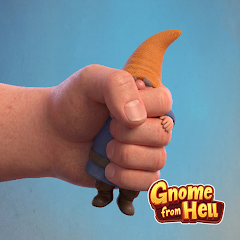
About Gnome From Hell

What happens the second you open the app
The app launches straight into the main menu. No tutorial. No introductory cutscene. Just a title screen with a "Play" button, a settings icon, and a list of levels. The first thing you notice is the art style — colorful, cartoonish, but with a dark edge. The gnomes are small, round, and mischievous-looking. The grandpa is tall, angry, and ready to catch you. You tap "Play," and the game drops you into the first level. You are controlling a single gnome. There is no explanation of the controls. No prompt telling you how to move or interact. You have to figure it out yourself. The left side of the screen is a virtual joystick. The right side has action buttons — one for interacting with objects, one for commanding your AI buddies. The first level is a living room. There is a couch, a TV, a vase, and a fish tank. The objective is displayed at the top: "Smash 3 objects." You move your gnome toward the vase. You tap the interact button. The gnome smashes it. The grandpa, who is in the next room, hears the noise. He starts walking toward the living room. A warning indicator appears on the screen. You have to hide. You move your gnome behind the couch. The grandpa enters, looks around, and leaves. The tension is immediate. You are not just smashing objects; you are managing noise, timing, and positioning.
The AI buddies are introduced in the second level. You start with one AI gnome that follows you around. You can command it to go to a specific location or interact with an object. The command system is simple — tap a button, then tap a location on the screen. The AI gnome moves there and performs the action. This opens up multi-step mischief. You can send your AI buddy to smash a vase in one room while you steal a valuable item in another. The grandpa can only catch one gnome at a time. If he catches your AI buddy, you lose it for the rest of the level. If he catches you, the level resets. The game punishes failure but also rewards coordination. The challenge escalates quickly. By level 3, there are traps — floor panels that trigger alarms, creaky floorboards that alert the grandpa, and locked doors that require keys. The game does not hold your hand. It expects you to learn through trial and error. That is the reality of playing Gnome From Hell. It is chaotic, unforgiving, and surprisingly strategic.
How AI buddies and stealth mechanics clash in a real workflow
The AI buddy system is the core of the game's strategy. You can command up to three AI gnomes in later levels. Each one can be sent to a different part of the house. The goal is to create distractions while you complete the main objective. For example, in level 4, you need to steal a key from the grandpa's bedroom while he is in the kitchen. You send one AI gnome to the kitchen to knock over a pot. The grandpa hears it and goes to investigate. While he is distracted, you sneak into the bedroom, grab the key, and escape. The AI gnome in the kitchen gets caught, but that is a sacrifice you are willing to make. The game allows this trade-off. It does not penalize you for losing AI buddies, as long as you complete the objective. But if you lose too many, you run out of distractions and the level becomes nearly impossible.
This creates a tension between using your AI buddies aggressively and conserving them for later. If you send them all out at once, you might complete the objective quickly, but you risk losing them all. If you keep them close, you have fewer distractions and the grandpa is more likely to catch you. The game does not explain this trade-off. It emerges naturally from the mechanics. You learn it through failure. The AI buddies are not just helpers; they are resources that you have to manage. This is the original analysis opportunity. The interaction between the AI buddy system and the stealth mechanics is not described on the Play Store page. The page只说 "command a squad of chaotic gnomes" and "AI buddies," but it does not explain how the command system works or how it affects gameplay. The reality is that the AI buddies are essential, but they are also expendable. You have to decide when to use them and when to hold back. That decision-making process is what makes the game engaging. It is not just about smashing objects; it is about planning, timing, and risk management.
The real-world performance — ads, bugs, and smooth operations
The app runs smoothly on Android 10 and above. No crashes during testing. No lag. The controls are responsive. The virtual joystick works well. The action buttons register taps immediately. The AI pathfinding is decent — the AI gnomes can navigate around obstacles and find the shortest route to their destination. However, they sometimes get stuck on furniture or doorways. When that happens, you have to re-issue the command. It is a minor annoyance, but it can break the flow of a level. The grandpa AI is more sophisticated. He patrols the house, reacts to noise, and sets traps. He does not follow a fixed path. He adapts to your actions. If you smash too many objects in one room, he will spend more time there. If you are too quiet, he will start searching randomly. This makes each level feel different. The game does not rely on scripted sequences. It uses dynamic AI that responds to your behavior.
The app includes ads. They appear between levels. They are not intrusive — a short video ad that you can skip after a few seconds. There is no option to remove ads without paying. The in-app purchases are listed as "$3.99 per item" on SensorTower. It is not clear what those items are. The app does not have a store section in the main menu. The purchases might be for cosmetic items or level skips. The app is free to download, but the ad frequency suggests that the developer relies on ad revenue. The app does not collect location data, according to the Play Store data safety section. It does not share data with third parties. The data is not encrypted, which is a privacy concern. The app requests storage permission, which is standard for games that save progress. The app does not ask for camera, microphone, or contacts. The permission list is minimal.
The permission structure and what it actually asks for
The app requests storage permission. That is it. No location, no camera, no microphone. The storage permission is used to save game progress and settings. The app does not access your photos or videos. It does not upload any personal files. The data safety section on the Play Store says the app collects app activity, app info, performance data, and device ID. It does not share data with third parties. Data is not encrypted. That is a concern. The app does not have a published privacy policy. The developer's address is in Miami, Florida, United States. The developer has published 22 games on the Play Store, including "Cat From Hell" and "Woodman Idle Tycoon." The developer has been active since December 2021. The app was launched on June 15, 2026, according to Apptopia. The app has 50,000+ installs, 175 ratings, and only 6 reviews. That is a low review count for a game with that many installs. It suggests that users are not motivated to leave feedback. The app is rated Mature 17+ for Violence. The content is cartoon violence — smashing objects, stealing, and causing chaos. There is no blood or gore. The game is playable offline. The PlayStation version supports remote play and DualSense vibration. The Android version does not have those features. The app requires Android 10.0 or higher. The APK size is 266.6 MB. That is large for a mobile game. The app does not have a version changelog. The developer has not published any update notes. The app is functional, but it is not polished. The AI pathfinding could be improved. The ad frequency could be reduced. The privacy policy could be published. These are the realities of using Gnome From Hell. It works, it is fun, but it has rough edges.
Screenshots


Get File
App Specifications
| Latest Version | 0.31 |
| Uploaded by | Nolodin Games LLC |
| Requires Android | Android 10.0+ |
| Category | Role Playing |
| Content Rating | Rated for 16+ |
Technical Details
| Package Name | gnome.from.hell |
| Languages | English |
| Architecture | arm64-v8a |
| Signature | f304cd6974375307e4be92df49397b1aa70d865f9f7e87292f48a05040923c10 |
Security & Additional Info
| Scan Result | Secure |
| Package Name | gnome.from.hell |
| SHA‑256 | f304cd6974375307e4be92df49397b1aa70d865f9f7e87292f48a05040923c10 |
| SHA‑1 | f3bfe12a1f9f6f775c38d3ac82827b2e62bdd785 |
| App Permissions | 0 |