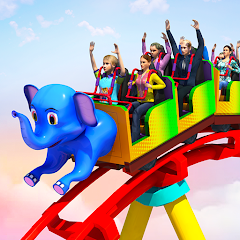
About Roller Coaster Simulator HD

Installing Roller Coaster Simulator HD for the first time presents a straightforward setup: a loading screen, a brief tutorial prompt, and then a garage-like menu with a single coaster track and a few buttons. The game's opening moments are deceptively simple. Players are given a basic coaster and a few themes to experiment with, but the real complexity hides beneath the surface.
The initial screen shows a park map with a few pre-built tracks. A "Build" button opens a menu with track pieces, supports, and scenery options. The tilt control feature is immediately accessible, allowing players to bank turns and adjust the angle of their coasters. However, the tutorial does not explain how the physics engine calculates G-forces or why certain track configurations cause the coaster to stall. This lack of guidance becomes apparent within the first few minutes of play.
One of the first things a new player notices is the ad frequency. After completing a single test run, a full-screen video ad appears. Close it, and another ad pops up when navigating back to the menu. The game's free-to-play model relies heavily on advertising, and this becomes a defining aspect of the experience. Players who have purchased the "No Ads Pack" report a much smoother experience, but for everyone else, the interruptions are relentless.
When Tilt Control Meets Track Design: A Physics Disconnect
The tilt control system is one of the game's most touted features. Players can adjust the banking of turns, the pitch of drops, and the roll of loops. In theory, this should allow for realistic coaster designs that mimic real-world physics. In practice, however, the physics engine does not always respond as expected. A sharply banked turn that should produce high G-forces might instead result in a floaty, unrealistic sensation. Conversely, a gentle curve might trigger a jarring jolt that throws the virtual riders out of their seats.
This disconnect between the visual design and the simulated physics creates a frustrating feedback loop. Players spend time meticulously crafting a coaster, only to find that the test run feels nothing like what they intended. The game's "smooth tilt controls" are smooth in terms of input, but the output is often unpredictable. This is compounded by the fact that the game does not provide any real-time feedback on G-forces, speed, or rider comfort during the design phase. Players must run a full test ride to see the results, and if the physics are off, they have to go back and tweak individual track pieces.
One workaround that experienced players have discovered is to use the "automatic banking" feature, which adjusts the tilt based on the track's curvature. This often produces more realistic results than manual adjustment, but it also removes much of the creative control. The game's strength—customization—becomes its weakness when the underlying physics fail to support the player's vision. This is a classic case of a game that offers depth but lacks the simulation fidelity to back it up.
The Reality of Performance: Ads, Bugs, and Monetization
Real-world performance of Roller Coaster Simulator HD is a mixed bag. The game runs smoothly on most mid-range devices, with users praising its optimization. "It runs smoothly on low-end devices, making it accessible to a wider audience," one review stated. Graphics are another strong point, with multiple users describing them as "great" and "cute." However, the game's performance is hampered by two major issues: excessive ads and persistent minor bugs.
Advertisements appear not just between races, but also during menu transitions and even when pausing the game. One user on the Apple App Store complained, "every few seconds, an add would appear. The ads come just as you are going into a spot and it causes you to fail." Another called it the "worst ad abusing app I've seen." The frequency of ads is a deliberate monetization strategy, but it significantly degrades the user experience. The "No Ads Pack" is available for $9.99, but many players consider this price too high for a game that otherwise offers limited content.
Bugs are another persistent issue. The changelog for version 3.3.4 lists only "minor bugs fixed," and the iOS version mentions "Camera Angle changed minor bug fixes." These vague entries suggest that the developer is aware of issues but is not addressing them in a meaningful way. Users have reported crashes during track editing, save file corruption, and the occasional disappearance of custom coasters. One reviewer noted that "it has started crashing a lot and the crashing has erased my progress a few times." The lack of specific patch notes erodes trust in the developer's commitment to quality.
Technical Details and Platform Differences
Roller Coaster Simulator HD requires Android 7.1 or higher, making it compatible with devices released in the last several years. The APK size varies by version, with the latest builds hovering around 121 MB. The game also supports controller input, which is a welcome feature for players who prefer physical controls over touchscreen. The iOS version requires iOS 13.0 or later and has a significantly larger file size of approximately 199.8 MB, suggesting different asset optimization between platforms.
The version history shows a pattern of incremental updates. Version 3.3.4, released in September 2024, was 91.1 MB. By version 3.7 in April 2026, the size had grown to 121.2 MB. The most recent version as of this writing is 3.3.4 on Google Play and 1.3.4 on iOS, with the iOS version last updated on April 14, 2026. The changelog for both platforms remains vague, listing only "minor bug fixes" and "stability improvements." This lack of transparency is a recurring theme in user reviews, with many expressing frustration that the same issues persist across updates.
The game's privacy policy indicates that data is encrypted in transit, but some data is shared with third parties, including location and financial information. This is a concern for privacy-conscious users, especially given the game's free-to-play model with in-app purchases. The developer, 7Seas Entertainment Limited, is based in Hyderabad, India, and has a portfolio of other simulation and racing games. The company's stock is publicly traded on the BSE, indicating a level of corporate accountability, but this has not translated into better communication with users about bug fixes and feature updates.
Screenshots


Get File
App Specifications
| Latest Version | 3.9.1 |
| Uploaded by | 7Seas Entertainment Limited |
| Requires Android | Android 7.1+ |
| Category | Simulation |
| Content Rating | Rated for 3+ |
Technical Details
| Package Name | com.sevenseas.RollerCoasterHD |
| Languages | English |
| Architecture | arm64-v8a |
| Signature | f5cb8af24dcc8f4e1c19c45792ba3e7c9c39607cb5e8555c8568402cc109eb97 |
Security & Additional Info
| Scan Result | Secure |
| Package Name | com.sevenseas.RollerCoasterHD |
| SHA‑256 | f5cb8af24dcc8f4e1c19c45792ba3e7c9c39607cb5e8555c8568402cc109eb97 |
| SHA‑1 | f266ed9998ee349e149b094a9a628a6aa949c7ed |
| App Permissions | 0 |