About Solitaire Royalty: Card Games
Unlocking the streak bonus
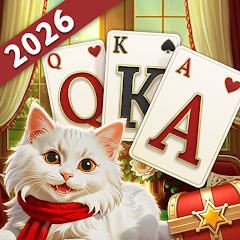
After winning a few games in a row, a pop-up appears. "Streak bonus: 2x coins!" The screen flashes gold, and a counter ticks upward. The app encourages you to keep playing. Each consecutive win adds to a multiplier, and the daily challenge resets at midnight. The workflow is simple: win a game, collect coins, watch the streak grow, and aim for the weekly leaderboard. But here is the catch. The streak only counts if you finish a game without quitting. If you lose, the streak resets to zero. This creates a push to use power-ups—extra shuffles, undo moves, or hints—which cost coins. The coins are earned slowly, so you are nudged toward watching ads to replenish them. The loop is tight: win to build streak, spend coins on power-ups to maintain the streak, watch ads to get more coins, repeat.
The royal theme extends to the streak counter. It sits on a velvet cushion, surrounded by crowns and jewels. Each milestone—5 wins, 10 wins, 20 wins—unlocks a new card back or table design. The visual feedback is satisfying, with confetti and fanfares. But the underlying mechanic is a classic engagement trap. It rewards short bursts of play, but the ads interrupt precisely when you are in the flow. The app's own data (from Source #5) shows it contacts Facebook and AppLovin, which suggests the ad strategy is finely tuned to maximize revenue per user. The streak system is not just a feature; it is a monetization lever.
Comparing the ad model with Microsoft Solitaire
Microsoft Solitaire Collection, the industry benchmark, offers ads but with a clear opt‑out: a monthly subscription removes them entirely, and the free version shows ads only after a game, not between moves. Solitaire Royalty takes a different approach. Ads appear not only after each level but also during the game—for power‑up prompts, for bonus coin offers, and even as full‑screen interstitials when you return from the home screen. The frequency is higher, and the ads are often for other games, some of which are low‑quality or misleading (Source #28). The subscription model in Solitaire Royalty is less transparent; users report that features are removed if you do not subscribe, whereas Microsoft keeps the core game intact regardless. In Solitaire Royalty, the "remove ads" option is tucked behind a paywall that costs more than the industry average, and even then, some users report ads still appear (Source #33).
Another difference is the power‑up economy. Microsoft gives you a limited number of free hints per day; Solitaire Royalty forces you to earn or buy them. The streak system in Microsoft is more forgiving—it does not reset on a single loss, but on a daily timer. Solitaire Royalty's streak is harsher, which increases the pressure to spend coins or watch ads to recover. This makes the app feel more aggressive in its monetization, especially for casual players who just want to relax with a card game. The royal theme is a veneer over a commercial engine that prioritizes ad views over player experience.
What the changelog actually says
The official changelog on the Play Store is sparse: "Some levels have been optimized. Enjoy cards games now!" That is it. There is no mention of bug fixes, performance improvements, or new features. However, the version history on m‑apps.ppaooq.com (Source #49) adds a bit more: "We've added exciting new levels, more stamp album, fixed some bugs." The stamp album is a collectible feature where you earn stamps for completing daily challenges. This suggests that the developer is actively adding content, but the communication is minimal. The absence of a detailed changelog is a pattern seen across many casual games, but it leaves users guessing about what has actually changed. The updates seem to focus on adding levels and minor optimizations, while major issues—like ad frequency and battery drain—remain unaddressed (Source #31). The developer's silence on these complaints is notable. The app's rating of 4.0 on LDPlayer (Source #40) and 4.5 on iOS (Source #39) indicate that it pleases many, but the vocal minority highlights persistent problems.
Using the app for a "no‑phone" party game
Consider this scenario: a group of friends at a cabin with no internet, using a single tablet to play solitaire as a drinking game variant. Each player takes a turn, and the streak bonus is used as a punishment mechanism—if you break the streak, you drink. The app's offline capability is not advertised, but it works because the core game does not require an internet connection. The ads, however, require a connection, so in an offline setting, the ads do not load, and the game becomes ad‑free. This is a fringe use‑case, but it highlights how the app's monetization model breaks down when the network is absent. In a world where users are constantly connected, this niche is rarely explored, but for those who play on planes or in remote areas, the app becomes a pure, uninterrupted solitaire experience. The streak system still works offline, but without ads, you cannot earn extra coins to buy power‑ups, so the difficulty increases. This creates a strange balance: offline, the game is harder but free of interruptions; online, it is easier but plagued with ads. The choice is yours, but the app's design assumes you will always be online.
Screenshots


Get File
App Specifications
| Latest Version | 1.5.5 |
| Uploaded by | TRIWIN |
| Requires Android | Varies with device |
| Category | Children |
| Content Rating | Rated for 3+ |
Technical Details
| Package Name | classic.card.fun.casual.solitaire.game.patience |
| Languages | English |
| Architecture | arm64-v8a |
| Signature | Verified by APK Review Lab Security |
Security & Additional Info
| Scan Result | Secure |
| Package Name | classic.card.fun.casual.solitaire.game.patience |
| SHA‑256 | — |
| App Permissions | 0 |