About Text or Die

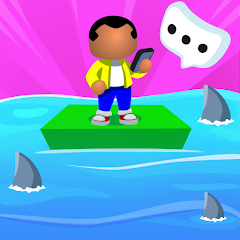
The game opens with a simple prompt: "Name a type of fruit." The timer starts ticking. A keyboard appears at the bottom of the screen. Type "watermelon" and a stack of blocks rises beneath your character. Type "apple" and the stack barely grows. This is the core tension of Text or Die. Every question is a race against time and against other players, but the real competition is against the game's own word database. Longer answers mean more blocks, and more blocks mean a taller tower. The tower keeps you above the rising water. The sharks circle below. Get the answer wrong or run out of time, and your tower crumbles. The water rises. The sharks get closer. The game ends.
This is not a traditional trivia game. There are no categories to choose from, no difficulty settings to adjust. The game throws questions at you from a vast, seemingly random pool: "Name a type of clock," "Name a type of coffee," "Name a type of edible fish." The variety is broad, but the answers are not always what you expect. "New York" is accepted, but "New York City" is not. "Nightstand" is accepted, but "bedside table" is not. The game has a specific list of acceptable answers, and if your word is not on that list, you lose. This creates a frustrating experience where the player's knowledge is secondary to the game's database. The game does not tell you what is accepted and what is not. You learn by failing, and failure means watching an ad to continue.
The Tower and the Water: How the Mechanic Works
The tower-building mechanic is the game's most distinctive feature. Each letter in your answer adds one block to your tower. The goal is to build the tallest tower possible before the timer runs out. The rising water level is the same for all players, so the player with the tallest tower wins. This creates a simple, visual feedback loop: longer answers = taller tower = higher chance of survival. The mechanic is easy to understand and provides immediate gratification when you type a long word. However, the game does not explain the scoring system in detail. There is no tutorial that tells you that each letter equals one block. You figure it out through trial and error. The game also does not tell you that some answers are worth more than others. "Watermelon" might be worth 10 blocks, but "strawberry" might be worth 10 as well. The length of the word is the only factor. This simplicity is part of the game's appeal, but it also limits strategic depth. You are not rewarded for obscure knowledge; you are rewarded for knowing long words that the game's database accepts.
The multiplayer aspect is another layer of tension. The game claims to match you with real opponents from around the world. However, many users suspect that the opponents are bots. The game does not show usernames or profile pictures that would indicate real players. The matches feel scripted, with opponents often failing at the same time or giving the same short answers. This suspicion is reinforced by the game's frequent ads. If the opponents were real, the matchmaking and ad placement would need to be synchronized, which seems unlikely given the game's technical issues. The "multiplayer" experience feels more like a single-player game with a competitive skin, designed to create urgency and encourage ad views.
The Ad Economy: How the Game Makes Money
Ads are everywhere in Text or Die. They appear between rounds, after every wrong answer, and sometimes even during gameplay. The game is free to download, and the ads are the primary revenue source. The in-app purchases are secondary, offering ad removal for $7.99 and various coin packs. The ad frequency is a major point of frustration for users. One user described the game as "一款以接广告为生的益智游戏" (a puzzle game that lives off ads). The ads are often unskippable and can last up to 30 seconds. This disrupts the flow of the game and makes it feel more like an ad-viewing platform than a trivia game. The game's design seems to encourage failure, as failure triggers an ad view. This creates a perverse incentive: the game benefits when you lose. The "try again" feature requires watching an ad, so even if you know the answer, you might be forced to watch an ad to continue. This is a common monetization strategy in mobile gaming, but in Text or Die, it feels particularly aggressive because the game is so unforgiving.
The game's technical performance adds to the frustration. Users report frequent crashes, lag, and freezing. The game buffers and kicks players out mid-level. The typing input is sometimes laggy, making it difficult to type long words before the timer runs out. These issues are not isolated; they are mentioned across multiple reviews and platforms. The game's size, which can exceed 200 MB, is also a concern for users with limited storage. The combination of aggressive ads, technical issues, and a questionable multiplayer system creates a product that feels unfinished and exploitative.
What the Changelog Actually Says
The Play Store changelog for Text or Die is remarkably vague. The most recent entry, as of this writing, simply states: "We gave things a polish so you can play without pause. Update now for smoother gameplay!". This is a generic statement that does not specify what was fixed or improved. The absence of a detailed changelog is a common issue with many apps, but it is particularly noticeable here because the game has so many reported problems. Users want to know if the update addresses the frequent crashes, the lag, or the ad frequency. The changelog provides no such information. This lack of transparency erodes trust. It suggests that the developer is either not aware of the issues or is not prioritizing them. The third-party sources, such as APKPure, show that the game is updated frequently—there are versions from April, May, and July 2026. However, the changelog for these updates is not published on the Play Store. Users are left to guess what has changed. This is a missed opportunity for the developer to communicate with their user base and build goodwill.
The game's data safety section on the Play Store states that data is encrypted in transit and that no data is collected. This is a positive aspect. However, the app does share data with third parties, according to the Play Store's data safety section. The exact nature of this data sharing is not specified. The app also has 15 permissions, according to third-party sources. These permissions are typical for a game, but they are not listed on the Play Store page itself. This lack of transparency is a concern for privacy-conscious users.
One specific technical detail: the game requires Android 7.0 or later. This is a relatively high requirement for a trivia game. The app size varies significantly between versions, from 135 MB to 206 MB. This suggests that the game's assets are not optimized, which may contribute to the performance issues. The game also supports both arm64-v8a and armeabi-v7a architectures, which is good for compatibility. However, the large size and high OS requirement may limit the game's accessibility for users with older or lower-end devices.
Screenshots


Get File
App Specifications
| Latest Version | 30.0.1 |
| Uploaded by | Rollic Games |
| Requires Android | Varies with device |
| Category | Kids |
| Content Rating | Rated for 3+ |
Technical Details
| Package Name | com.fullfat.textordie |
| Languages | English |
| Architecture | arm64-v8a |
| Signature | Verified by APK Review Lab Security |
Security & Additional Info
| Scan Result | Secure |
| Package Name | com.fullfat.textordie |
| SHA‑256 | — |
| App Permissions | 0 |