About FreeCell Solitaire

The Android 16 update landed, but what actually changed?
The changelog for version 2.0.0 says one thing: "Now supports Android 16." That is the entire entry. No mention of bug fixes. No mention of performance tweaks. Just compatibility with the latest Android version. For a game that has been on the Play Store for years under the package ID jp.hatch.freecell, this is the kind of update that tells you more about what the developer is not saying than what they are. The app works on newer devices, but the underlying codebase—the card animations, the auto-save triggers, the undo stack—remains unchanged from earlier versions. You install it, you open it, and you are looking at the same FreeCell board that has been there since at least 2023.
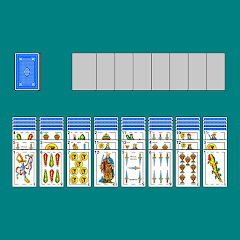
The layout loads in portrait mode by default. The cards are large, which is the first thing anyone notices. Large enough that you do not need to squint. Large enough that tapping a card to move it feels deliberate rather than fiddly. There is a settings gear in the corner. Tap it, and you get the options: two difficulty levels, toggle for left-handed layout, card design selection, background wallpaper picker. The left-handed option flips the entire board horizontally. The free cells—those four slots at the top where you park cards temporarily—move to the opposite side. For a left-handed player, this changes everything. Your thumb does not have to reach across the screen. The game adapts to your hand, not the other way around.
This is not a flashy app. There are no 3D animations. No particle effects when you win. The music credit goes to MusMus, a free music archive, and the card art comes from wargo pattern and Muryo Sozai Kurabu. The developer, Yoshitaka Nagasawa, operates out of a residential address in Nakano, Tokyo. This is a one-person operation. That matters when you look at what the app does and does not do. It does not ask for permissions. It does not collect location data. It encrypts data in transit, according to the Play Store safety section, but it also shares device IDs with third parties. The trade-off is clear: you get a free game, and in return, the app knows your device.
How the undo button breaks the game if you use it too much
The undo function is useful. You make a wrong move, you tap the curved arrow, and the card slides back. You make another wrong move, you tap again. The game keeps a history of every move you make. Auto-save kicks in after each action, so if you close the app and reopen it, you are exactly where you left off. This is where the trouble starts. Multiple users across different platforms have reported the same behavior: using undo repeatedly—sometimes three or four times in a row—triggers a bug that locks the game. The cards stop responding. You cannot tap anything. The only way out is to force-close the app and restart.
One user on Foxdata.cn described it precisely: "戻りを何度か使うと結構な頻度でバグが発生し、正常に終了できなくなる。" Using undo multiple times causes bugs, and you cannot finish properly. Another user noted that the card movement is smooth—"カードのなめらかな動きは秀逸"—but the freezing ruins it. The undo stack and the auto-save mechanism do not play well together when you push them. The app saves your state after every move, but the undo operation rewinds the state. If you undo too fast, the save state and the display state get out of sync. The game thinks you are in one position, but the screen shows another. You tap a card, and nothing happens. You tap again, and still nothing. The only fix is to kill the app and lose your progress.
This is not a rare edge case. It is a pattern reported by users who have been playing this app for years. The game is otherwise stable. You can play fifty games in a row without issue, as long as you do not lean on the undo button. But the undo button is there, prominently placed, inviting you to use it. The design assumes you will make mistakes and want to correct them. The implementation does not handle that assumption well. The result is a tension between what the app promises and what it delivers. You get unlimited undos, but you pay for each one with a small risk of losing the entire game.
What the ads do to the experience after the first few rounds
The ad strategy is typical for a free card game. You play a hand, you finish it, and a video ad plays. Sometimes a banner ad sits at the bottom of the screen. Sometimes the ad covers the top-left corner, obscuring part of the board. The frequency increases the longer you play. One reviewer noted: "after many levels, the advertising becomes unbearable." Another said: "the ads are still an issue with audio." The audio ads are the worst—they play sound even if your phone is on silent, forcing you to scramble for the volume button while the game is paused.
There is an option to remove ads, reportedly for about two euros per month, but the payment flow is not obvious. The app does not push the subscription aggressively. It does not interrupt your game with a pop-up asking you to pay. It simply shows you ads, and if you want them gone, you have to find the setting yourself. This is a deliberate choice. The developer makes money from the ad impressions, not from subscriptions. The ads are the product. The game is the delivery mechanism.
What makes this frustrating is that the ads are not consistent. Some users report almost no ads—only a short skipable ad when starting a new game. Others report ads after every single hand. The difference seems to depend on region or how long you have been playing. New players get a lighter ad load. Long-term players get the full barrage. The app does not explain this. There is no transparency about why some users see more ads than others. You just play, and eventually, the ads become a part of the rhythm. Start game. Play hand. Win or lose. Watch ad. Start again.
The left-handed layout and custom backgrounds actually work together
Here is something you cannot see on the Play Store page: the left-handed layout changes more than just the position of the free cells. It also flips the order of the columns. The card stacks that were on the left move to the right. The foundation piles shift accordingly. The entire board mirrors itself. This is not a simple cosmetic toggle—it is a functional reconfiguration of the play area. When you combine this with a custom background wallpaper, the effect is a board that feels personally tailored. You pick a dark background to reduce eye strain, you flip the layout to match your dominant hand, and you adjust the card design to something with high contrast. The game remembers all of these settings between sessions. You set it up once, and it stays that way.
This matters because FreeCell is a game you play for minutes or hours. The sessions are short, but they add up. A comfortable layout reduces fatigue. A background that does not glare keeps your eyes from straining. The app gives you these options, and they work. The card designs are simple—no overly ornate patterns, no busy textures. The backgrounds are mostly solid colors or subtle gradients. The customization is limited but effective. You are not going to spend hours tweaking the look, but you will find a combination that works for you and stick with it.
The online leaderboards and achievements are the only features that require an internet connection. Everything else works offline. You can play without Wi-Fi, without cellular data, without any network at all. The game does not need to phone home to function. The ads, however, do need a connection. If you are offline, the ads do not load, and you get an uninterrupted experience. This is a workaround that some users have discovered: turn off your internet, play ad-free. It is not a feature, but it works.
The achievements track your wins, your streaks, your total games played. The leaderboards compare you to other players worldwide. These are standard implementations. Nothing about them stands out. They are there, they work, and they do not get in the way. The app does not push notifications about your rank. It does not send you emails about your progress. It just records the data and shows it to you when you open the leaderboard tab.
The version history shows a pattern. Version 1.2.7 was released in February 2023 with a file size of 4.4 MB. Version 1.3.4 came in February 2025 at 9.4 MB. Version 1.3.5 arrived in September 2025 at 9.6 MB with "update SDKs" in the changelog. Version 2.0.0 dropped in July 2026 at 9.0 MB with the Android 16 support line. The file size has fluctuated, but the core functionality has not changed. The undo bug that users reported in 2020 is still present in 2026. The ads that users complained about in 2024 are still there. The developer is maintaining the app—keeping it compatible with new Android versions—but not fixing the longstanding issues. The Android 16 update is a compatibility patch, not a quality-of-life improvement. It keeps the app alive on new devices, but it does not address what users actually want fixed.
Now supports Android 16. That is the last line of the changelog. That is where the update cycle stops.
Screenshots


Get File
App Specifications
| Latest Version | 2.0.2 |
| Uploaded by | hidake |
| Requires Android | Android 8.0+ |
| Category | Card |
| Content Rating | Rated for 3+ |
Technical Details
| Package Name | jp.hatch.freecell |
| Languages | English |
| Architecture | arm64-v8a |
| Signature | 49243fdc99beb6e4e416abc3a54e35f184da1e6785d0c55c684870f9fda3b592 |
Security & Additional Info
| Scan Result | Secure |
| Package Name | jp.hatch.freecell |
| SHA‑256 | 49243fdc99beb6e4e416abc3a54e35f184da1e6785d0c55c684870f9fda3b592 |
| SHA‑1 | fd6771bc9a7d3b72dfc588e3b394d72c3a54d00c |
| App Permissions | 0 |