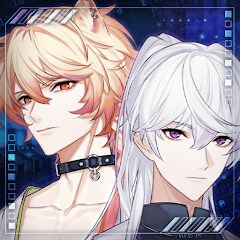
About Hearts in Sirence

The Weight of a Winged Stranger
The café door swings open. A man with wings stumbles in, and suddenly the world you knew collapses. This is Nagi, and he carries the Chimera Complex — a disease that twists human bodies into animal forms. No one survives it for long. You have just finished your master's degree. Job offers pile up on your phone. But none of that matters now. Three men now depend on you: Reo, the patient who bites back; Shizuki, the boss who watches every move; and Nagi, the stranger who fell from the sky. This is where Hearts in Sirence begins. Not with a tutorial. Not with a menu screen. With a choice that changes everything.
Interactive Studio Inc. built this visual novel for players who want romance wrapped in a sci-fi apocalypse. The setting is bleak. The mutations are irreversible. Yet the game asks you to heal hearts, not just bodies. Each character represents a different kind of wound. Reo lashes out because he expects betrayal. Shizuki keeps his distance because trust is a liability. Nagi searches for freedom because he has never known it. Your job is to navigate these three paths, one conversation at a time. The narrative branches based on your responses, and the game does not telegraph which choice leads where. That uncertainty is part of the design.
Reo, Shizuki, Nagi — Three Routes, One Apocalypse
Hearts in Sirence does not hide its structure. You meet Reo first — your assigned patient. He is loud, sharp-tongued, and covered in feline features that mark his mutation. His route is about breaking through anger to find the grief underneath. Shizuki appears later, cold and precise, running the institute where you work. His route demands patience; he gives nothing away for free. Nagi, the winged stranger, is the emotional core. His route asks whether hope can survive in a dying world. Each path offers a different ending, and the game encourages multiple playthroughs to see them all.
What the Play Store page does not say is how these routes interact. Playing one route changes how you see the other characters. Reo's aggression looks different after you have seen Shizuki's calculated kindness. Nagi's fragility hits harder when you know Reo's survival instinct. The game does not force this connection. It simply presents the characters as they are, and your memory does the rest. That is the quiet strength of this visual novel. It trusts you to hold multiple truths at once.
Comparing Hearts in Sirence with Other Otome Games
Genius Inc. and Interactive Studio Inc. have released dozens of visual novels. Titles like "Crimson Chaos" and "Wardens of Romance" follow similar formulas: choose a love interest, make decisions, reach an ending. Hearts in Sirence differs in one key area. The stakes are not just romantic — they are existential. The Chimera Complex is not a backdrop. It is a ticking clock. Every character carries the disease or its consequences. This creates a sense of urgency that other otome games often lack. You are not just choosing a partner. You are choosing who lives and who does not.
Compared to "The Lost Fate of the Oni" or "My Assassin High School," this game leans harder into science fiction. The mutations are described in clinical detail. The global conspiracy involves research labs, government cover-ups, and ethical breaches. It is darker than the typical Genius Inc. offering. Players who enjoy "Chimera: Complex Hearts" — the earlier title with a similar premise — will find familiar ground here. But Hearts in Sirence refines the formula with tighter writing and more distinct character voices.
What the Changelog Actually Says
The latest version, 3.0.0, carries a changelog that reads: "Minor bug fixes and improvements." That is it. No detail on what was fixed. No mention of new content. This is not unusual for Interactive Studio Inc. Their updates tend to be vague. But it does raise a question: what exactly needed fixing? User reports from other Genius Inc. games mention occasional crashes, save file issues, and translation errors. Whether these affect Hearts in Sirence is unclear. The developer has not published specific patch notes. The app remains functional, but the lack of transparency is worth noting.
One practical detail stands out. The game requires Android 7.0 or higher. The APK file size is approximately 62.4 MB. Installation requires additional space for cache and saved data. These are standard requirements for a visual novel of this length. However, the game does not support cloud saves natively. If you uninstall, your progress disappears. This is a limitation that players should consider before starting a route. The game also offers multiple languages, including English, Japanese, and Chinese, which expands its reach beyond the Japanese market.
A Bizarre Use Case from the Research Log
One forum post describes using Hearts in Sirence as a writing exercise. The player replayed each route multiple times, noting how dialogue choices altered character reactions. They mapped the decision tree manually, creating a flowchart of possible outcomes. This is not how most people play visual novels. But it reveals something about the game's design. The branching paths are complex enough to sustain this kind of analysis. The choices are not cosmetic. They lead to distinct scenes, different character development, and unique endings. For a free game, that level of depth is unusual.
The game's structure also allows for a peculiar interaction: choosing the "wrong" answers on purpose to see how the characters react negatively. Reo becomes more hostile. Shizuki withdraws further. Nagi grows more desperate. These negative outcomes are as well-written as the positive ones. The game does not punish you for making bad choices — it simply shows you the consequences. This is a rare quality in otome games, where the focus is usually on achieving the "best" ending. Hearts in Sirence treats all endings as valid, which adds replay value and emotional weight.
Screenshots


Get File
App Specifications
| Latest Version | 3.0.0 |
| Uploaded by | Interactive Studio Inc. |
| Requires Android | Android 7.0+ |
| Category | Simulation |
| Content Rating | Rated for 12+ |
Technical Details
| Package Name | jp.interactive_studio.chimera |
| Languages | English |
| Architecture | arm64-v8a |
| Signature | e7a39a1eff09dcf1854ab7cc24a2b222eae836536f300b03156c743a15750e9a |
Security & Additional Info
| Scan Result | Secure |
| Package Name | jp.interactive_studio.chimera |
| SHA‑256 | e7a39a1eff09dcf1854ab7cc24a2b222eae836536f300b03156c743a15750e9a |
| SHA‑1 | 3b6477603fd71fb1df7d6d30eca307d032d25ca9 |
| App Permissions | 0 |