About One More Brick

The Setup Reality: What Happens When You Open It
The moment One More Brick loads, you are met with a clean screen and a single aiming line. There is no tutorial video, no long introduction, just a finger waiting to be placed on the glass. The game drops you directly into its core loop: aim, swipe, release. A single ball flies upward, hits a brick, and bounces. That is the entire onboarding process. Less than three seconds from tap to action. This immediate entry point is what keeps players coming back, but it also hides the depth that emerges after a few rounds. The simplicity is deceptive. Behind that one-finger swipe lies a physics engine that treats every bounce differently, and the bricks do not just sit there waiting to be broken. They shift, they stack, and they demand precision. The game does not ask for permission to start. It just begins.
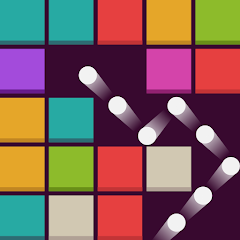
After the first few swipes, the screen fills with color. Bricks in rows, some with numbers on them indicating how many hits they need. The aiming line moves with your finger, and the release sends a ball on a trajectory that can either clear half the screen or bounce uselessly off a single corner. This is where the habit forms. One more round becomes ten, and ten becomes an hour. The developer, Rifter Games, built this for exactly that purpose: a time-killer that fits in a pocket and works without a signal. The offline capability is not a bonus; it is a core design choice. No Wi-Fi, no problem. The game runs locally, and the only interruption is the occasional ad that pops up between rounds. That interruption, however, is where many players start to feel the friction.
Two Power-Ups, One Chaotic Result
One More Brick features a handful of power-ups, but two of them change the game entirely when used together. The ball duplicator splits every active ball into two, and the double bouncer makes each ball bounce twice as many times before leaving the screen. On their own, each is useful. The duplicator helps clear dense clusters, and the bouncer increases the chance of hitting hidden bricks. But together, they create a cascade that is both satisfying and uncontrollable. Activate both at the same time, and the screen becomes a pinball machine on overdrive. Balls multiply, bounce off every surface, and bricks crumble in seconds. The score climbs fast, but so does the chaos. You lose the ability to predict where any single ball will go. The game shifts from a precision exercise to a spectacle.
This interaction is not explained anywhere on the Play Store page. The developer lists the power-ups as separate features, but the emergent behavior of combining them is something you only discover through trial and error. And it is not always beneficial. The chaos can work against you. Balls that bounce too wildly might miss key bricks, leaving a stubborn cluster that forces you to start over. The game does not punish you for using both, but it does not reward you either. It simply lets the physics take over. This is the kind of detail that separates a casual play session from a deeper engagement. It is also the kind of detail that keeps players returning, even when they complain about the ads or the difficulty spikes.
What the Changelog Does Not Tell You
The official changelog for One More Brick says the same thing almost every time: "Bug fixes and performance improvements." That is the only update note available. No specifics on what changed, no mention of new levels or adjusted difficulty curves. The developer, Rifter Games, has kept a tight lid on the details. This silence is noticeable because the game has been updated multiple times over the years, with version numbers climbing from 2.8.1 to 3.4.8. Each update presumably tweaks something, but players are left to guess. Some have reported that ad behavior changed after certain updates, with ads becoming more frequent or less predictable. Others have noticed that the aiming sensitivity feels different after a new version installs. Without a transparent changelog, these perceptions become the de facto patch notes.
One consistent observation across multiple sources is that the game's economy shifted at some point. Previously, you could watch an ad to continue a level or earn extra stars. Now, some players report that those options require spending stars instead, and stars are harder to come by. This change is not documented anywhere official, but it is a recurring theme in user discussions. The game remains free, but the cost of progression has subtly increased. Whether this is a deliberate design choice or an unintended consequence of a bug fix is unclear. What is clear is that the changelog does not help clarify anything. The phrase "performance improvements" could mean anything, and players are left to discover the changes on their own.
The Permission That Matters: Location Access
One More Brick requests access to location data. This is not a typical requirement for a brick-breaking game. The Play Store listing mentions that the app may collect location information, app info, and device IDs, and that data is encrypted in transit. For a game that works entirely offline, the location request raises questions. It is likely tied to ad targeting, as many free-to-play games use location data to serve region-specific advertisements. But the app does not explain this upfront. The permission screen appears during installation, and most users probably tap "Allow" without thinking. For those who decline, the game still functions normally. There is no obvious penalty for denying location access. The game runs, the bricks break, and the ads still appear. This suggests that location is not critical to gameplay, but rather a background data collection mechanism.
The developer, Rifter Games Ltd, is based in London, United Kingdom. The company address is listed on the Play Store, and the privacy policy indicates that data may be shared with third parties. For a casual arcade game, this level of data collection is not unusual, but it is worth noting. The game is free, and ads are the primary revenue source. Location data helps those ads be more relevant, which in theory increases the likelihood of clicks. Whether that trade-off is acceptable is up to each individual user. What is certain is that the game does not need location to function. You can play it on a plane, in a basement, or anywhere without a signal, and the bricks will still break. The permission is there for the business model, not the gameplay.
Screenshots


Get File
App Specifications
| Latest Version | 3.4.8 |
| Uploaded by | Rifter Games |
| Requires Android | Varies with device |
| Category | Arcade |
| Content Rating | Rated for 3+ |
Technical Details
| Package Name | com.riftergames.onemorebrick |
| Languages | English |
| Architecture | arm64-v8a |
| Signature | 1b404201893443803ca4e54a8ede21d1a6a0f4bc73481f23512f381ea6f221f5 |
Security & Additional Info
| Scan Result | Secure |
| Package Name | com.riftergames.onemorebrick |
| SHA‑256 | 1b404201893443803ca4e54a8ede21d1a6a0f4bc73481f23512f381ea6f221f5 |
| SHA‑1 | ba47300c34d86c1b8ca58e52db4848ba9296b48b |
| App Permissions | 0 |