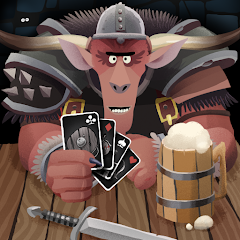
About Card Crawl 2

Open the app and you are greeted with a 4-column board
Launch Card Crawl 2 and the first thing you notice is the layout. Instead of the original's single row of four cards, you now face four columns stacked with cards. Up to sixteen cards sit on the board at once. Only the top card of each column is visible. The rest are hidden, waiting to be revealed. Your hero card sits in your hand with 13 health. On each turn, you get three actions. You can attack enemies, cast spells, drink potions, collect coins, or discard cards. The goal is simple: clear the board of monsters before they kill you. But the path to victory is anything but straightforward.
The game is a sequel to the 2015 original, developed by Arnold Rauers and his team at Tinytouchtales, based in Berlin. It was released on March 26, 2026, exactly eleven years after the first game. The new layout was inspired by Jakub Wasilewski's Solitomb and Rauers' own Gnomitaire. The core loop remains familiar, but the expanded board adds a new layer of strategy. You can now equip items, collect spells, and unlock heroes with unique abilities. The game is free to download, with optional in-app purchases and a subscription to remove ads.
The pouch problem: 250 coins and a merchant who wants more
The coin system is the game's most controversial feature. You earn coins by defeating monsters and completing runs. By default, your pouch can hold a maximum of 250 coins. The merchant sells items, spells, and heroes. Many of these items cost more than 250 coins. One user reported seeing items priced at 275 coins and above. To buy them, you have two options: upgrade your pouch through in-app purchases, or store coins in a backpack slot that bypasses the limit. The backpack method works, but it is slow and requires careful inventory management. The pouch upgrades are permanent, but they cost real money. The base upgrade costs $5.99, and there is a second upgrade beyond that.
This system has drawn criticism. One user wrote, "商店没有任何用处,物品全是275以上的金币,问题只能存250金币,想买物品,必须升级钱包容量(充值)" — the shop is useless because items cost over 275 but you can only hold 250, forcing you to pay to upgrade. Another review noted that "monetization undermines the experience in important ways." The developer, Arnold Rauers, acknowledged this in a blog post, explaining that the free-to-play approach was a deliberate shift from his traditional shareware model. He described the monetization as "mild," but users disagree. The pouch limit creates a friction point that feels less like a gentle nudge and more like a barrier.
What the changelog fixed and what it didn't touch
The game receives frequent updates. The patch notes, hosted on the official website, list dozens of fixes and additions. Version 167 added a restart adventure option and challenge notification icons. Version 166 introduced the Adventure mode, along with French and Italian translations. Version 165 added Korean translations and fixed auto-selling backpack items. Version 164 fixed a Classic Constructed unresponsiveness bug. The changelog is extensive, covering everything from blessing descriptions to crossbow targeting issues. The developer is clearly committed to polishing the game.
However, the changelog does not address the pouch limit. It does not mention the tutorial bug that some users reported, where the game fails to recognize 15+ gold earned during the tutorial. One user on AppReview.jp noted, "チュートリアルの最後がクリアできない タイトル通りです。チュートリアル最後は15ゴールド以上稼いでクリアとなるはずですが、モンスターを倒して15ゴールド以上稼いでいても,また同じチュートリアルが始まります。" — the tutorial cannot be cleared even with 15+ gold. A quick bug fix update was released for the tutorial issue, according to the iOS version notes, but some users reported the problem persisted. The pouch limit, however, remains untouched. It is a design choice, not a bug, and the developer has not indicated any plan to change it.
The art, the music, and the missing French translation
The game's presentation is one of its strongest assets. The art, by Max "Mexer" Fiedler, is charming and distinctive. The music, by Oliver Salkic and Sam Webster, is atmospheric and engaging. The interface is clean and responsive. The game feels polished, which is remarkable for a free-to-play title. However, the French translation has been a point of contention. One App Store reviewer wrote, "Le jeu a l'air top mais avec l'absence de traduction française je n'arrive pas à me mettre dedans…" — the game looks great but without French translation, I can't get into it. The developer added French translations in version 166, addressing this complaint. The game now supports multiple languages, including Korean, which was added in version 165.
The game also features a Weekly Tavern Crawl mode, where players compete using a shared deck configuration. This is a fair test of skill and decision-making, as everyone has the same tools. The mode is competitive and adds long-term replayability. However, the monetization system can give paying players an advantage, as they can upgrade their pouch and access more items. This undermines the fairness of the Weekly Tavern Crawl, as noted by one reviewer: "monetization hurts competitive play." The game is fun, but the competitive integrity is compromised by the pay-to-advance mechanics.
How the pouch limit and the merchant system work together
Here is the original analysis: the interaction between the pouch limit and the merchant system creates a deliberate friction point. The merchant offers items that cost more than the default pouch can hold. This is not an accident. It is a calculated design choice to encourage in-app purchases. The backpack slot offers a workaround, but it is inefficient and requires sacrificing inventory space. The pouch upgrades are permanent and relatively affordable, but they are still a barrier for free players. The game is generous in many ways—you can unlock all heroes and cards without spending money, as one user noted. But the pouch limit is a persistent reminder that you are playing a free-to-play game. The friction is mild compared to other games, but it is still noticeable. It creates a tension between the game's strategic depth and its monetization model. The game is at its best when you are focused on the cards, not the coins. But the pouch limit keeps pulling your attention back to the shop.
The game is free, and the core experience is solid. The strategy is deep, the presentation is beautiful, and the replayability is high. But the pouch limit is a flaw that will frustrate some players. It is not game-breaking, but it is a constant reminder that the developer needs to make money. The game is worth playing, but go in with your eyes open. The pouch limit is not going away.
Screenshots


Get File
App Specifications
| Latest Version | 169 |
| Uploaded by | Arnold Rauers |
| Requires Android | Android 7.1+ |
| Category | Card |
| Content Rating | Rated for 7+ |
Technical Details
| Package Name | com.tinytouchales.crawlitaire |
| Languages | English |
| Architecture | arm64-v8a |
| Signature | 8184fbf1b7175a7ef7228f69bc460983a5b0af61809fcbc514747af5345ccf67 |
Security & Additional Info
| Scan Result | Secure |
| Package Name | com.tinytouchales.crawlitaire |
| SHA‑256 | 8184fbf1b7175a7ef7228f69bc460983a5b0af61809fcbc514747af5345ccf67 |
| SHA‑1 | ad585d31867db19a1e8d2904b1b07625d2b796c9 |
| App Permissions | 0 |