About Dragon GO

The AR Camera Opens First, Then the Dragon Appears
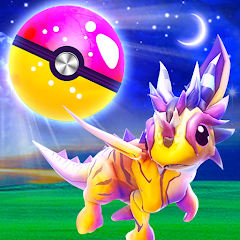
Opening Dragon GO for the first time triggers the camera immediately. The app asks for permission to access the camera before anything else appears on screen. No splash screen, no tutorial — just a camera viewfinder with a small radar dot in the corner. The radar pulses gently, indicating a dragon is nearby. You have to physically move your phone around, scanning your environment, until the radar fills up and a dragon materializes on your screen. The dragon floats in mid-air, rendered in 3D, and you tap it to initiate the capture sequence. A pokeball-like sphere appears, and you swipe upward to throw it. The catch mechanic is simple: swipe and hope the dragon stays inside. There is no curveball mechanic, no timing-based bonus. Just a straight throw. If you miss, the dragon disappears and you have to find another one. The Play Store description mentions AR and dragon catching, but it does not explain that the camera is mandatory for every single catch attempt.
The game does not require GPS. That is a deliberate design choice, mentioned prominently in the feature list. You can play entirely indoors, in a room with no windows, as long as the camera can see something. The radar works based on device orientation, not location. This sets it apart from Pokemon Go, which locks most of its gameplay behind physical movement. In Dragon GO, you spin in place, point your phone at the ceiling, and a dragon appears. The AR tracking is basic — the dragon stays fixed in place relative to the camera, but it does not anchor to surfaces. It floats in the air, ignoring tables and walls. The illusion breaks if you move too fast, but for a casual game, it works well enough. The key workflow is: open camera, find dragon, throw ball, repeat. There is no walking, no real-world exploration, no stops or gyms. Just you, your camera, and a rotating collection of dragons.
Comparing the Catch Mechanic to Pokemon Go
Pokemon Go requires you to walk to specific locations, spin Pokestops, and throw curveballs with precise timing. Dragon GO removes all of that. You stand still, point your phone, and throw. The pokeball imagery is identical — a red-and-white sphere that wobbles after a successful catch. Multiple user reviews on chrome-stats.com call out this similarity, with some directly accusing the game of copying Pokemon Go. The visual design of the catch screen is almost a direct replica, down to the placement of the ball and the dragon's position in the center of the screen. But the mechanics are simpler. There is no berry system to calm the dragon, no curveball spin, no nice/great/excellent throw bonuses. You just swipe. The dragon either stays in the ball or it does not. The randomness feels unfair at times, especially when a low-level dragon escapes three times in a row.
Resource management is also different. In Pokemon Go, you collect Pokeballs from stops. In Dragon GO, you start with a limited number of balls and there is no clear way to get more. User reviews on chrome-stats.com mention "no store, no way to obtain resources" and "limited in-game resources (e.g., berries)". The game gives you five berries to attract dragons, and once they are gone, there is no obvious way to get more. You can feed, hug, and care for your caught dragons to earn extra crystals, but those crystals do not buy pokeballs. They buy cosmetic upgrades. This progression dead-end frustrates players. The game feels incomplete, like a prototype that launched before the economy was designed. Compared to Pokemon Go's robust item economy, Dragon GO feels hollow.
What the Changelog Says — and What It Doesn't
The official Google Play changelog is empty. No text, no update notes, no list of fixes. The APKPure version history shows that version 1.3.7 was released on June 12, 2026, with a changelog that reads: "Minor bug fixes and improvements." That is the same generic phrase used for version 1.3.6, version 1.3.2, and likely every version before that. The developer, Talking Pet, has never published a detailed changelog anywhere. The version history shows a pattern: version 1.3.2 was 57.3 MB, released August 22, 2023. Version 1.3.7 is 51.5 MB, released June 12, 2026. The file size decreased by nearly 6 MB over three years. That suggests the developer optimized assets or removed unused content. But without a proper changelog, players have no idea what actually changed.
The rating distribution tells a clearer story than the changelog. AndroidRank.org shows 1,191 total ratings, with 470 five-star reviews and 599 one-star reviews. That is a brutal split. Almost half of all users gave the game the lowest possible rating. The average rating sits at 2.77. The one-star reviews on chrome-stats.com use phrases like "total garbage", "Amazingly sucks it's so trash and so lagy", and "I hate it so much because you can only have like five berries to get dragons." The game is not being updated to address these complaints. The changelog does not mention performance improvements, even though lag is the most common complaint. The developer is either ignoring feedback or treating this as a side project. The lack of transparency is a problem, and it shows in the numbers.
The Bizarre Use-Case: Catching Dragons Without Leaving Your Chair
One of the most unusual aspects of Dragon GO is that you can play it entirely without moving. The "play without GPS" feature is not just a convenience — it is a fundamental design choice that changes the entire experience. You can sit in a chair, point your phone at a blank wall, and the radar will still find dragons. The AR camera does not need to recognize surfaces or measure distances. It just needs to see something. The dragon appears in the center of the screen, and you throw the ball. This creates a bizarre use-case: the game becomes a stationary dragon-collecting simulator. You do not explore. You do not walk. You do not interact with the real world in any meaningful way. The AR is a visual gimmick, not a gameplay mechanic.
This use-case is not documented anywhere on the Play Store. The Play Store mentions AR and camera usage, but it does not explain that you can play effectively by pointing your phone at the ceiling. The combination of the AR camera requirement and the GPS-free design creates a paradox: the camera is mandatory, but location is optional. Most AR games require both. Dragon GO requires only one. The result is a game that feels like a tech demo — a proof-of-concept for AR dragon catching that never evolved into a full experience. The merge system, the 150+ dragons, the level cap of 30 — all of these features exist, but they sit on top of a core loop that is fundamentally broken. The lag makes it unplayable for many. The resource economy is non-existent. The changelog is empty. And yet, the dragons are detailed. They are visually appealing. Some users love them. That is the bizarre, niche use-case that keeps the game alive: a stationary AR dragon collector with beautiful dragons and nothing else.
Screenshots


Get File
App Specifications
| Latest Version | 1.3.7 |
| Uploaded by | Talking Pet |
| Requires Android | Android 6.0+ |
| Category | Adventure |
| Content Rating | Rated for 3+ |
Technical Details
| Package Name | com.laugh.dragongo |
| Languages | English |
| Architecture | arm64-v8a |
| Signature | 46e2916e8bb259d6931c2af4e38b339f2eef83fca708dcc074e638d2c80c2046 |
Security & Additional Info
| Scan Result | Secure |
| Package Name | com.laugh.dragongo |
| SHA‑256 | 46e2916e8bb259d6931c2af4e38b339f2eef83fca708dcc074e638d2c80c2046 |
| SHA‑1 | 94b091627b572377b32625bc874abce48d32576d |
| App Permissions | 0 |