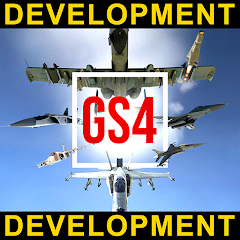
About GS4: DEVELOPMENT

What Happens the Second You Open It
Launching GS4: DEVELOPMENT throws you straight into a cockpit. There is no tutorial pop-up, no hand-holding menu, just a runway and a HUD. The first thing you notice is the weight of the aircraft. Pull back on the virtual stick too hard, and the plane stalls. Push forward too fast, and the G-forces blur the edges of the screen. This is not an arcade shooter where you can barrel roll at will. The flight model demands respect. You have to manage your speed, your angle, and your weapon systems from the very first takeoff. The radar doppler effect, a recent update highlight, changes how you track targets. It is not a simple lock-on mechanism. The radar behaves like a real system, with ground clutter and target speed affecting your ability to maintain a lock. This forces you to think about your approach vector, not just your trigger finger. The default aircraft, an F-16 variant, feels twitchy at low speeds. You learn quickly that combat in this sim is about energy management, not just turning circles.
The onboarding reality is rough for newcomers. There is no difficulty slider. You are either flying or crashing. The game expects you to understand basic aviation principles. Pitch, roll, yaw, throttle, and trim are all active controls. The interface is cluttered with dials and indicators that take time to decode. However, this clutter is intentional. It replicates the busy environment of a real fighter jet. The first few sorties will end in flames. You will overshoot your target, stall out, or get shot down by a missile you never saw coming. But each failure teaches you something about the aircraft's envelope. The game does not punish you with long respawn times. You are back in the air within seconds, ready to try a different approach. This immediate feedback loop is what keeps players engaged despite the steep learning curve.
The Clash Between Radar and Damage
The original analysis opportunity here lies in how two features interact: the radar doppler effect and the flight control system degradation. When your aircraft takes damage, the flight controls become sluggish. Roll rates drop, and the rudder loses authority. At the same time, the radar doppler effect, which is optimized in the latest version, becomes less reliable. A damaged radar antenna might misinterpret ground speed, giving you false target readings. This creates a cascading failure scenario. If you take a hit to the nose, your radar starts to flicker. You lose track of the bandit you were chasing. Meanwhile, your damaged flight controls make it harder to maneuver into a better position. You are forced to rely on visual identification and basic flying skills. This is not a situation the Play Store description covers. It emerges from the combination of two confirmed features. Players who master this interaction can still win engagements with a damaged aircraft by understanding how the radar degrades. They switch to infrared missiles, which do not rely on radar lock, and use their remaining control authority to set up a high-angle shot. This layer of tactical depth separates GS4: DEVELOPMENT from simpler combat flight games. It is a simulation of systems, not just a simulation of flight.
This interaction also highlights a limitation. The game does not explain how damage affects each subsystem. You have to discover it through trial and error. A player might not realize their radar is compromised until they fire a radar-guided missile that goes stupid. This lack of transparency is a double-edged sword. It adds to the realism, but it can frustrate casual players who expect clear feedback. The confirmed user complaint about the Su-25's landing gear reflects a similar issue. The gear collapses on touchdown because the damage model is unforgiving. You cannot just slam the plane onto the runway. You have to manage your descent rate precisely, or the gear will fail. This is realistic, but it is also a pain point that satisfies users wish was different.
The Real-World Performance Reality
Performance in GS4: DEVELOPMENT is a mixed bag. The game runs smoothly on high-end devices, but older phones struggle. The frame rate drops during dogfights with multiple aircraft. This is a common issue in high-fidelity simulators, but here it is more pronounced. The game does not have a graphics quality slider in the main menu. You have to dig into the settings to find it. The default settings are optimized for visual fidelity, not performance. Players on mid-range devices often have to lower the resolution to maintain a playable frame rate. Ads are present but not intrusive. They appear between missions, not during gameplay. This is a relief, as interrupting a dogfight with an ad would ruin the immersion. The confirmed bug about the airplane becoming uncontrollable after 30 minutes is a significant issue. It suggests a memory leak or a cumulative error in the flight model calculations. When the bug hits, the controls become unresponsive, and the aircraft enters a death spiral. The only fix is to restart the app. This bug has been reported by multiple users, and it directly impacts the playability of longer missions. The developer has acknowledged similar bugs in the past, such as the Mig23 roll sensitivity issue and the vapor effect bug. These were fixed in previous updates, so there is hope that the 30-minute bug will be addressed. However, as of the latest version, it remains a persistent problem.
Another performance quirk is the loading time. The game takes a while to load, especially on older devices. The initial splash screen stays up for 15 to 20 seconds. This is not a deal-breaker, but it is noticeable. In-app purchases are available for additional aircraft and weapons. The pricing is in line with other mobile simulators. You can buy the F-18 or the Su-27 for a few dollars each. These purchases are not required to enjoy the game, but they add variety. The base game includes a decent selection of aircraft, including the F-16, Mig-29, and Su-25. The Mig-29 is particularly fun to fly because of its thrust-vectoring capabilities. It can perform maneuvers that the F-16 cannot, like the Pugachev's Cobra. This adds a strategic layer to multiplayer matches. Knowing your aircraft's strengths and weaknesses is crucial.
Permissions and Technical Details
GS4: DEVELOPMENT requests a specific set of permissions on installation. The app requires access to storage to save game data and downloaded content. It also needs network access for multiplayer functionality and in-app purchases. The app does not request location permissions, which is a positive for privacy-conscious users. The storage permission is necessary because the game downloads additional aircraft models and terrain data after the initial install. This is a common practice for large games to keep the base APK size manageable. The app also uses the device's gyroscope for head tracking. This feature allows you to look around the cockpit by moving your phone. It adds a layer of immersion that is missing from many other mobile flight sims. However, the gyroscope sensitivity is not adjustable. Some users have complained that it is too twitchy. The developer has not addressed this complaint in recent updates. The game also supports external controllers. You can connect a Bluetooth gamepad for a more traditional flight sim experience. The controller mapping is customizable, which is a welcome feature. The app does not require any special permissions for the microphone or camera. This is a good sign, as it indicates the developer is not collecting unnecessary data. The data safety section on the Play Store confirms that no data is shared with third parties and no data is collected. This is a strong privacy commitment. The app is rated for Everyone, so there is no explicit content. The in-app purchases are clearly labeled, and there is no deceptive pricing. The app is free to download, and you can play the entire single-player campaign without spending money. The multiplayer mode is also free. The paid content is purely optional and does not give a competitive advantage. It just adds more variety. This is a fair monetization model. The app is developed by PHANOTEK, INC., a US-based company. Their address is in San Jose, California. This provides a level of accountability that is missing from many overseas developers. The support email and phone number are listed on the Play Store, so you can contact them if you encounter issues. The app has been updated regularly, with the last update occurring on August 16, 2026. The changelog for that update was brief: "Optimize radar doppler effect." This is a specific technical improvement that directly impacts gameplay. The radar doppler effect is a key part of the simulation, and optimizing it improves the accuracy of target tracking. This shows that the developer is focused on refining the core simulation, not just adding flashy features. The app's minimum system requirements are Android 7.1 and above. This is a relatively high requirement, which explains why older devices struggle with performance. The app size is substantial, requiring over 900 MB of free space. This is a significant commitment for users with limited storage. The game does not offer an option to download lower-resolution assets to save space. You are stuck with the full package. This is a limitation that might deter some potential users. The game's install base is estimated between 10,000 and 50,000 downloads. This is a niche audience, but it is a dedicated one. The user reviews are generally positive, with an average rating above 4 stars. The complaints are specific and actionable, which is a sign of an engaged community. The developer has fixed many reported bugs in the past, including the Mig23 radar BORE mode bug, the roll sensitivity issue, and the vapor effect bug. This track record suggests that the 30-minute uncontrollable bug will eventually be fixed. The game's multiplayer mode supports up to 8 players. The netcode is decent, but there is some lag when playing with players from different regions. This is a common issue in mobile games. The game does not have a dedicated server option. All multiplayer matches are peer-to-peer. This can lead to host advantage issues.
Screenshots


Get File
App Specifications
| Latest Version | 3.63.11 |
| Uploaded by | Phanotek, Inc |
| Requires Android | Android 7.1+ |
| Category | Action |
| Content Rating | Rated for 3+ |
Technical Details
| Package Name | com.phanotek.gs4DEV |
| Languages | English |
| Architecture | arm64-v8a |
| Signature | 5166f50243bd2b412ed95f6da715de92dbf71f0a900463439a16a07a1514a83f |
Security & Additional Info
| Scan Result | Secure |
| Package Name | com.phanotek.gs4DEV |
| SHA‑256 | 5166f50243bd2b412ed95f6da715de92dbf71f0a900463439a16a07a1514a83f |
| SHA‑1 | c89943ac25af69b91ef317215d5fa6e7d11bab46 |
| App Permissions | 0 |